
The Ceding of Power to Choose

The Church

Notes from The Closing of the Western Mind by Charles Freeman (pt  3)

As we move into the 4th century, bishops of the churches under Constantine are welcomed into the overall structure of governance. This move not only gives them authority in their jurisdictions, usually center in the city, but it also gives them great wealth and status. Bishops in the metropolitan city-states were given considerable authority akin to governmental authority- the most influential of which is the ability to free slaves. p.205  

Bishops also had the power to uphold the laws adopted according to Nicene orthodoxy. Furthering the adoption and integration of religion into the patriarchal structure of the Roman empire.

Keep in mind that as the Bishops were becoming more powerful and influential in the city-states, in Rome they were still marginalized or on the fringes of power and governance.  The political power in Rome still rested with the pagan aristocrats of the senate. Here they followed the old ways and were active in maintaining the temples and altars of their gods and goddesses. As such they are able to maintain and uphold the value and virtue of discussion and the intellectual skill of debate. This was true in other areas of the Empire of course, but not as concentrated in governance as it was in Rome.

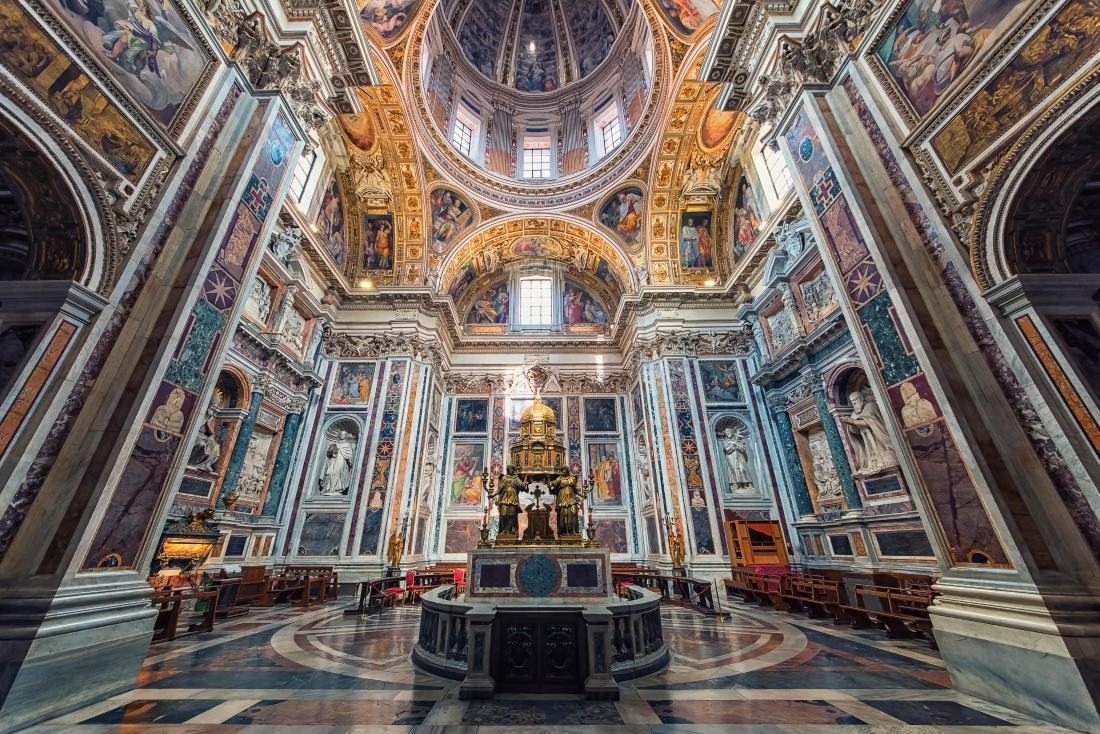
In other areas to the North as churches acquired resources, Basilicas became the literal architecture of the blending of church and state. Basilicas were large and some served as meeting houses of governance as well as places of worship. The new churches became the symbol on earth of heaven, with all of the opulence and riches on display, in order to inspire the congregation to strive toward the virtues of heaven. However, the wealth being poured into the construction of such churches placed a great burden on the population and its resources. p 210

To keep the poor quiet pagan/Roman tradition put on “bread and circuses”.  This tradition was shifted under Constantine to allow bishops to distribute food to the poor thus engendering broad support for them. Church leaders were also increasingly members of the elite class and were educated and gifted orators. These bishops were able to persuade and inspire their congregations. They were no longer the “ordinary men” of Christ’s disciples. 

This influence, along with the desire for control of surplus in taxes and other contributions, became a destructive force in the politics of the church. However, with these changes, the threat to the empire of those church leaders who renounced wealth, status and political power was taken care of. The church leaders, the bishops, were now some of the wealthiest and most powerful statesmen in their regions. No longer a threat to, but supporters of, the system.

As stated above, pagan rituals and rites were still taking place and gods and goddesses honored, especially by the elites of Rome. Traditional families, honoring their old ways were still common into the late 4th century. Remember though that Paul’s influence was still building and quite strong during this time. His message of rejection of all pagan gods and symbols had a strong influence in Rome where these families were still holding to pagan traditions. p 229

There was significant pressure from leaders and bishops to convert to Christianity.

Yet, there were still voices such as Symmachus, prefect of Rome, who wrote to prevent the removal of the pagan altars as they were symbolic of a diversity of the spiritual world and the freedom of thought that it allowed.  He was an advocate for move than one path to truth. This is a voice at a significant turning point, what a loss this diversity and freedom tuned out to be.

A final message from Oracle at Delphi p232

Go tell the King

Apollo’s lovely hall

Is fallen to the ground. No longer has the god

His house, his bay-leaf oracle, his singing stream.

The waters that spoke are stilled.

By the 5th century Christianity was dominant in Rome. 

Note: These musings are part of a larger writing project and are not complete in and of themselves.


The End of the Discussion?

Revisiting The Closing of the Western Mind by Charles Freeman (pt 2)

Did the Platonists help to set up the Greek/Roman embrace of Judaism and then Christianity?  This school of philosophy became entrenched in the idea of hierarchy and wove it into western thought.  This view also proposed the idea that the “good” at the top of the hierarchy became less so as the Forms moved into the material plane.  This leads to the support of the later notion of systemized religion that good comes from above and evil from below.  The earthly realm with all of its desires and pleasures become sinful by nature, needing redemption from above.

Sounding at all familiar?  This structure of reality becomes more accepted and other schools of thought are pushed to the fringes in Greece and therefore Rome.  At this time there was still some room for debate, but more and more the Platonists and their schools of thought define d the common narrative.

Here, we are tracing the path from lively debate, inquiry and metaphor to literal narrative, lecture and dogma in western culture and subsequently religion.  Specifically Judeo/Christian teaching is the key to understanding our current hierarchical, polarized information systems.  This is where western society shifts from teaching, writing and lively debate to writing as Law with debate held in check through tight containment and in some cases isolation.

An Example:

The writer and apostle, Paul, whose writings/letters have become canonical books of the Bible, was very likely to condemn Greek philosophy even though he was part of that culture residing in Tarsus.  Paul was interested in growing the Christian faith and being at the forefront of what this faith  would look like.  This book traces early Christian writings with an emphasis on Paul because of his reach into the Gentile world.  He had a broader platform through his travels and letter writings.

Paul’s issues with non-Christians are powerfully represented in his writings.  Some of these issues are based in his Jewish tradition like condemnation of idolatry. Other issues such as salvation and the centering humans in the cosmic drama — the drama of good vs evil, only redeemable upon death and the salvation of Christ — sets early Christians apart. As all others — people and beliefs — are abandoned by the Christian diety.  This is a fairly polarized belief system — one that does not invite thought, discussion or contemplation, this is a belief that requires only one thing — faith.

Through the influence of Paul, early Gentile Christians began to further isolate themselves — they isolated themselves from Jewish Christian communities by rejecting Hebrew law and Pagan communities with the rejection of their gods, idols, and practices.

…So we see the seeds being planted — the ending of debate and discourse and the beginning of dogma informing belief.

Note: These musings are part of a larger writing project and are not complete in and of themselves.

Can We Discuss It?

Have we lost the ability to disagree and maintain our relationships?  I remember my parents having discussions about politics especially in the Carter/Regan election years.  They were able to disagree with family and friends, make a joke and move on.  What is happening in our culture, especially here in the U.S?  Has fear of the other gripped us so tightly that we can no longer listen to what our neighbors have to say without feeling threatened?

In his book The Closing of the Western Mind, Charles Freeman notes that debate is what birthed scientific thinking in Greece.  A way of thinking based on observation and notion, and an opposing notion, ie hypothesis and null hypothesis.  Then the well organized argument (evidence) for or against the proposed notion.  This more logical, linear (perhaps) way of thinking was born of political debate sometime in the 5th c BC.  At this or a similar point in  the Western world it became desirable to be able to make an observation, social, political or natural, and reasonably argue to support that observation. Regardless of the embrace of logic and reason as ways to prove an argument or assumption, most of the thinkers in Greece were in agreement that dogma held no place in such discussions.

As example, around 311 there were two Athenian philosophical traditions.  These were emerging in addition to the Plato schools. Epicureanism and Stoicism emerged out of Athens as competing philosophies.  Stoics who believed it is our ability to think logically and reason that separated us humans from the natural world. This school of thought became most popular.  (Epicureanism, by contrast, was a relatively inclusive school of thought for the time as it included women as equal thinkers and teachers.)  What is important to know about this time is that none of these systems were closed.  In other words, they were open to debate.  How can a philosophy or world view stand if it cannot be questioned and discussed, except as a means of control.

According to Freeman, the Greeks under Roman rule maintained their intellectual debates.  When gathered the intellectuals of Greek society debated freely on mathematics, astronomy,  In fact, tolerance of different cults, beliefs, gods was the norm through the second century AD.  With this tolerance, the creativity and progress that comes from inspiration and learning thrived.  Philosophy was fueled by a desire to grow and improve oneself and one’s life and well as that of others.  It was not interested in being in possession of THE truth and imposing that belief on others if it did not appeal to them.

I’ll be writing more on this topic, including some influential ideas from Charles Freeman’s book.  I just want to get something posted this week and create a sustainable blogging habit:)

On Education

One of the reasons I started this blog came from our family’s move to Santa Fe, NM.  A beautiful, magical city in the high desert.  We moved from Portland, OR for a number of reasons, but the lure of sunshine would be at the top of my list.  

Our children were entering 2nd and 5th grade at the time, and had attended a sweet, unique school in Portland.  This public school had an environmental learning focus and there was considerable effort toward balancing classroom learning and outdoor learning.  Rigor and discipline were not at the forefront of the guiding principles at this school and there was a foundation of creative, project based style learning.

When we landed in Santa Fe, our children attended the local neighborhood school, which we had visited beforehand and thought was the better choice for them.  Within one month we were  disenchanted to say the least and looking for better options.  (This was due to the focus on academic rigor, standardized tests, and the strong focus on discipline.)  So this journey of inquiry into how we are domesticated via schooling began.

Lately I’ve been reading about the history of education in the U.S.  I was loosely aware that the industrial revolution had a profound influence on U.S. education policy and the resulting system.  The influence of the new, large, wealthy corporations was profound.  Most went about influencing the system through private foundations and their think tanks. Monetary influence and board member’s involvement in politics and government committees also had a major influence on schooling.  This is not dissimilar to today’s public education and political system.

When the focus of school or education shifted from an enriching curriculum of inquiry and critical thinking and/or acquisition of learning tools (reading, writing, mathematics) to a more systematic approach aimed at behavioral modification and training of job skills, the liberal arts style of education began to disappear from the public or compulsory school system.  

This is to serve as in introduction to a discussion and inquiry into this aspect of our domestication. Schools and American Education are structured to support a moral and social order.  It is the opinion of many great thinkers and critics of compulsory schooling in the United State that this system fosters individuals who passively consume information, regurgitate it for an exam and are at risk of losing any imaginative, critical thinking ability they are born with.

My intention is to continue to discuss and research the myriad ways we are programmed and stifled by systems and programming.